A clearer record of care. Exploring a better workflow for midwives.
My role
Research assistant
My work
Literature research & platform comparison
Project with
My professor
Problem
We wanted to understand how GLOWM’s medical records could better support midwives: finding a patient, reviewing earlier visits, and recording care with less effort.
GLOWM brings clinical guidance and record keeping into a mobile app. Our focus was the record-keeping experience and how it could better fit the flow of a visit.
Approach
My part in the research.
As a research assistant, I worked with my professor on the literature review and platform comparison. I helped organise the papers by topic, bring together recurring concerns, and identify areas of GLOWM to explore further.
Review the literature.We grouped papers around record usability, maternity care, mobile tools, and birth outcomes. This helped connect the interface questions to midwives’ wider work.
Compare record workflows.We looked at how GLOWM, OpenEMR, and OpenMRS organise patient information, visits, and data entry.
Turn gaps into suggestions.We brought the reading and platform review together to identify practical changes to explore for GLOWM.
This was literature research and platform comparison. We did not interview or observe midwives.
Why OpenEMR and OpenMRS?
Both are open-source systems built around patient records. They gave us examples of how other tools organise clinical information and visits, helping us question what GLOWM could make clearer.
Its configurable records and forms offered another way to think about organising information around different care needs.
Our aim was to find useful ideas for GLOWM. Any idea would need to suit midwives and a small phone screen.
What the reading added.
Scantlebury and colleagues described extra work when paper and electronic records ran alongside each other. Helou and colleagues showed that midwives and doctors can have different needs from the same record system.
These studies helped us ask whether information was easy to find and whether entering it fitted the work. The birth-outcome papers gave wider context for supporting midwives.
What we found in GLOWM.
The review pointed to three parts of the record-keeping experience that needed closer attention.
Patient lookup is split between the app and paper.
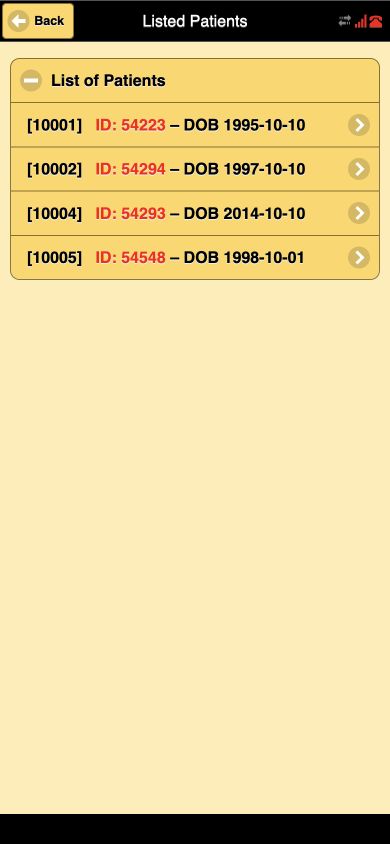
Before opening a record, a midwife needs to confirm the right patient. GLOWM’s list shows IDs and dates of birth, with no visible search or visit status. The app asks users to keep a separate handwritten name-to-ID list. This made patient lookup an area where we wanted to explore a clearer experience.
Earlier care sits inside separate record sections.
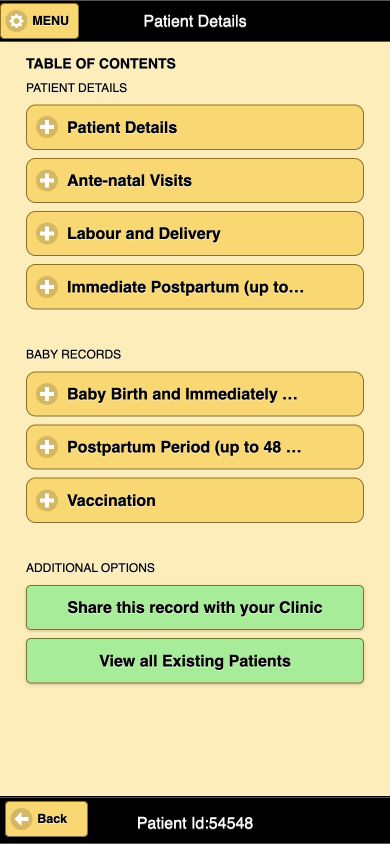
A midwife may need to check previous care before continuing a visit. GLOWM opens a record as a table of contents, with antenatal visits listed by number. Recent readings and visit dates are not brought together in the first view, so reviewing the history involves opening the relevant sections.
Recording a visit means working through a long form.
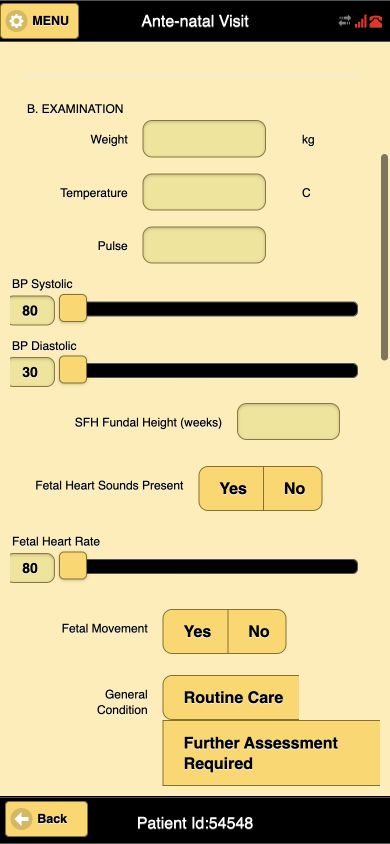
A single antenatal visit includes measurements, checks, and notes. GLOWM puts these into a long form with a mix of number fields, sliders, and yes/no choices. Some labels are repeated. We wanted to explore a clearer way to move through the visit and record exact readings.
Find the right record.Add patient-ID search and visit details, and review how to confirm identity while protecting privacy.
Review care at a glance.Bring key details, dated visits, and previous readings together, with unfinished work clearly marked.
Make visit entry clearer.Use short form sections, consistent number fields with units, and clear draft or completed status.
Impact
We developed a clearer set of workflow gaps and suggestions for GLOWM. My contribution was helping connect the literature and platform review to those priorities.
So far, our work has produced research findings and suggestions. User testing has not started yet.
Future work.
We want to redesign GLOWM using feedback from nurses. We are currently waiting for Institutional Review Board (IRB) approval to conduct research with people.
Once we receive approval, we plan to work with nurses at Drexel and other campuses in three stages:
Test the current app.Ask nurses to use GLOWM and share their experience. We want to understand what feels clear, where they get stuck, and what could be easier.
Redesign with their feedback.Use what we learn to improve the app’s navigation, record organisation, and data-entry flow.
Test the redesign again.Ask nurses to try the updated version and check whether the changes make the tasks clearer and easier to complete.